
Home / Costs and funding
How much does live-in care cost in Sussex, Surrey, Kent, Berkshire and Hampshire?
What families pay
Live-in care with us costs from £1,095 a week, in total.
That one weekly payment covers:
- Your carers' pay, passed on every week
- Ongoing access to the Homestay Carers service
- No entry fee, no exit fee, and two weeks’ notice if you need to stop
What can change a carer's fee:
- Care for a couple: from £1,260 a week if a partner only needs light help, such as meals and housekeeping, or £1,445 a week if both need care
- Bank holidays and Christmas: days a carer works on a bank holiday, Christmas Eve or New Year's Eve are charged at 15% extra, about £23 a day at our standard rate
- More complex physical needs, for example hoisting or manual handling
Breaks, holidays and changing carer
Your carer has two hours of breaks each day, usually split across the day. Live-in carers typically work in rotation, either three weeks on and one week off, or two weeks on and two weeks off. So we introduce two carers who share the role, and you meet and choose both. When one is off, the other is with your loved one. Your weekly arrangements stays the same whichever carer is with you.
If you'd like a different carer, tell us and we'll introduce new ones for you to meet.

How can live-in care be paid for?
Most families use a mix of their own money and help they're entitled to. Here are the main routes, in plain English.

Paying privately
Most families pay from income, savings, or both. Some use equity release or a care fees annuity: only ever with a regulated adviser who specialises in later-life finance.
Read moreCouncil funding and direct payments
Anyone can ask the council for a free needs assessment. In England for 2026–27, with savings over £23,250 you usually pay in full; between £14,250 and £23,250 the council contributes. For care at home, the house isn't counted.
Read moreNHS Continuing Healthcare
Free care, paid for by the NHS, for people whose main need is health care. A nurse, doctor or social worker fills in a short checklist first, and a full assessment may follow. It isn't means-tested, and it can pay for care at home.
Read moreCan Attendance Allowance help?
For people over State Pension age who need help with personal care. It isn't means-tested, and pays £76.70 or £114.60 a week (2026–27). Claim on form AA1, or call the helpline on 0800 731 0122.
Read more
Will we have to sell the house to pay for care?
If care is given in your own home, the council doesn't count the value of your home when it works out what you pay towards care.
In a care home, it usually does, after the first 12 weeks, unless a partner, or a relative aged 60 or over, still lives there. That's why many families end up selling the house to pay care home fees, or agreeing a deferred payment with the council, paid back from the house later.
With live-in care, the house stays yours, and stays a home. Read the full guide
General information, not financial advice. Everyone's situation is different, so check yours with your council or an independent adviser such as the Age UK Advice Line (0800 678 1602).
Not sure which applies to you?
We'll talk you through the options on a short call. You can also check what you might be entitled to with a free, independent benefits calculator, such as the Turn2us Benefits Calculator. Our free planning pack also includes a one-page funding checklist.
Compare costs in your area
Three quick questions. No email needed to see the answer.
Refine your estimate (optional)
Needs such as hoisting, Parkinson’s support, pets and smoking require an individual quote; no automatic surcharge is assumed.
Hourly visits, 4 hours a day
£1,036 a weekLive-in care with Homestay Carers
from £1,095 a week£57,175 a year including the supplied 10-day supplement assumption
Fully managed live-in agency
from £1,675 a weekNursing home in West Sussex
from £1,750 a weekPer person
For a fair comparison, live-in care also requires household bills and the carers’ food or allowance. Waking-night support is a different arrangement requiring a suitability discussion. The £245 advance comes off the first invoice.
| County | Homestay Carers, one person | Managed live-in agency, one person | Nursing home, one person | Homestay Carers, couple both needing care | Two nursing home places |
|---|---|---|---|---|---|
| West Sussex | from £1,095 | from £1,675 | £1,750 | from £1,445 | £3,500 |
| East Sussex | from £1,095 | from £1,675 | £1,950 | from £1,445 | £3,900 |
| Surrey | from £1,095 | from £1,675 | £1,950 | from £1,445 | £3,900 |
| Kent | from £1,095 | from £1,675 | £1,800 | from £1,445 | £3,600 |
| Berkshire | from £1,095 | from £1,675 | £1,900 | from £1,445 | £3,800 |
| Hampshire | from £1,095 | from £1,675 | £1,850 | from £1,445 | £3,700 |
Is live-in care cheaper than a Nursing Home?
Homestay Carers live-in carers
from £1,095 a week
Fully managed live-in agency
typically from £1,675 a week
Nursing home, our counties
£1,867 a week
Paying less doesn't mean more changes of carer. In CQC-registered home care agencies, nearly three in ten care workers leave their job each year (Skills for Care, 2025). With us, your carers aren't sent by an agency rota. You choose two regular carers who share the role for the long term.
Why live-in care makes the most sense for couples
In a care home, each partner pays for a full place. Across our six counties, a nursing home typically costs from £1,750 to £1,950 a week each, so £3,500 to £3,900 a week for the two. With live-in care, one carer at a time looks after both. If both need care, it's from £1,445 a week: less than half the cost of two nursing home places. If only one needs care and the other partner only needs help with meals and housekeeping, it's £1,260 a week. Moreover, not every care home can offer couples a room together or such personal levels of attention.
| Care option | Weekly cost | Basis |
|---|---|---|
| Live-in care for a couple | from £1,445 | One carer at a time supports both people. |
| Two nursing home places | £3,500–£3,900 | £1,750–£1,950 per person. |
To compare fairly: care home fees include food, heating and bills. With live-in care you keep paying your household bills and provide your carers' food, or a food allowance. You also stay in your own home, with one-to-one care.
When Live-In Care becomes more economical than Hourly Visits
Home care agencies in your area charge around £37 for a one-hour visit. Here's what that adds up to over a week compared to live-in care:
| Visits | Per week | What it covers |
|---|---|---|
| 1 hour a day | £259 | No one there for the other 23 hours |
| 2 hours a day | £517 | Short visits, often at fixed times |
| 4 hours a day | £1,035 | Still no one there overnight |
| 6 hours a day | £1,552 | Still no one there overnight |
| Live-in care with us | from £1,095 | A carer living in, there all day and overnight, with two hours of breaks a day |
A waking night carer typically charges around £30 an hour on top.
Why does an introductory agency cost less?
We're not CQC-registered and we don't manage care, so you stay in control and don't pay for managers. Fully managed agencies and introductory agencies like ours work in different ways, and the price reflects that.
1
Your carers are self-employed
A managed agency employs its carers, and the costs of employing , managing and training are built into the price.
2
No management layer to pay for
We don't run care plans, rotas or supervision visits, so you aren't paying for levels of coordinators and managers.
3
You pay for what you use
Your carers' pay, access to our service, carefully vetted carers, new introductions whenever you ask.
Common questions
Why aren't you registered with the CQC?
CQC guidance says introductory agencies do not need to register when they have no ongoing role directing or controlling personal care after an introduction. We introduce self-employed carers; families choose them and agree the care directly. Read about our model.
Are there any extra charges?
Only a few, and we confirm your price in writing before you go ahead. Days a carer works on a bank holiday, Christmas Eve or New Year's Eve are charged at 15% extra. The weekly price can also be higher for couples, more complex physical needs, Parkinson's care, pets or a smoking household. You provide your carers' food, or a food allowance, and a bedroom. There's no entry fee and no exit fee, and the £245 advance you pay to start the search comes off your first invoice.
What happens if the carer isn't right for us?
Tell us, and we'll introduce other carers for you to meet.
Can we use council funding to pay you?
Most families pay privately, but some get help. If the council funds part of the care, it can usually pay it as a direct payment, which you use to arrange your own care. Ask your council whether it can be used for live-in care through an introductory agency like ours, as councils vary. Attendance Allowance and NHS Continuing Healthcare can help too.
Questions about cost?
Arrange a short call and we'll confirm your price in writing. No obligation.
Still researching?
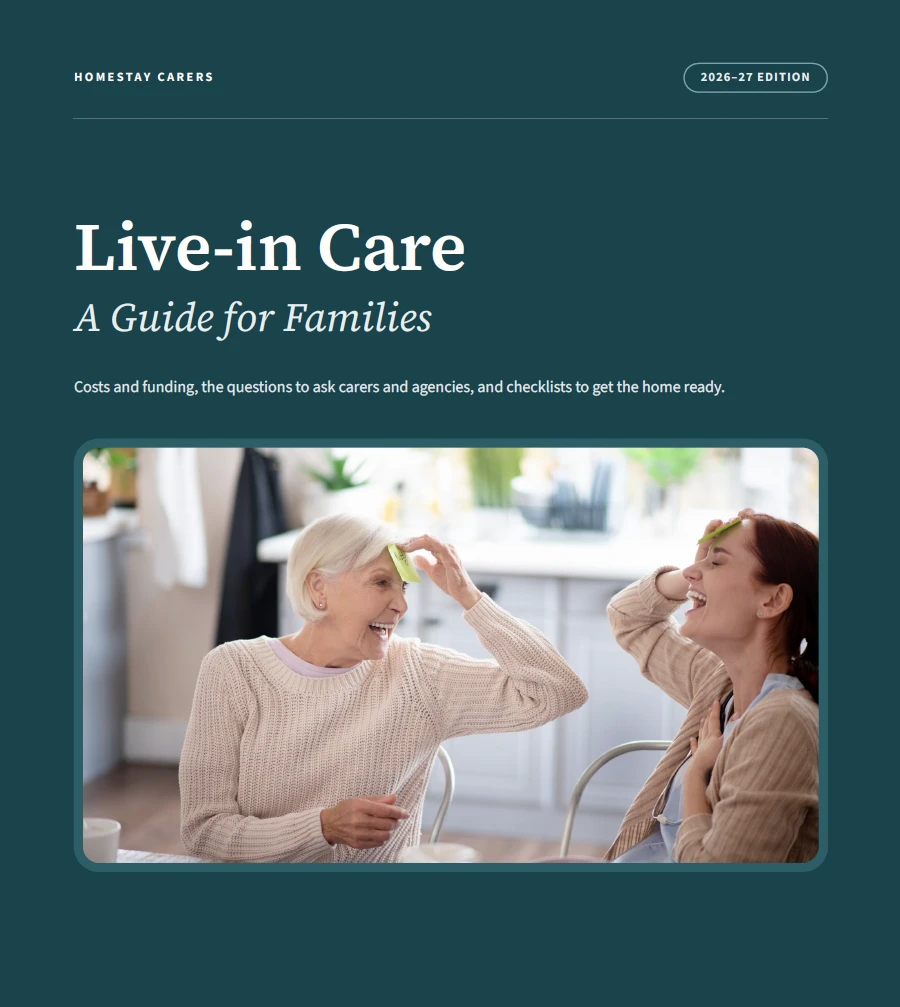
Live-in Care: A Guide for Families
Costs and funding, the questions to ask carers and agencies, and checklists to get the home ready.
Download the Planning Pack (PDF)Free, with no sign-up. Download the PDF to read or print it.
Browse our guides