
Home / Common questions
Common questions about live-in care
Straight answers to the questions families ask us most. If yours isn't here, arrange a call and ask us.

Getting started
How quickly can a live-in carer start?
It can be as quick as one week, if a hiring decision can be made quickly.
Do you visit us at home first?
Yes. We're based in Pulborough, West Sussex, and visit every family at home before introducing carers, usually within two days of your first call.
Which areas do you cover?
East Sussex, West Sussex, Surrey, Kent, Berkshire and Hampshire. See our area pages for the towns we cover.
Can I arrange live-in care for myself?
Yes. Many of the people we speak to are arranging care for a loved one, but you're very welcome to get in touch about care for yourself.
Do you offer short-term or respite care?
No. We introduce carers for ongoing live-in care only.

Costs and paying
How much does live-in care cost?
From £1,095 a week. The weekly payment covers your carers’ pay and our service. You provide your carer’s food and a separate bedroom. See what's included.
What does the weekly price cover?
Your carers' pay, passed on every week, and ongoing access to the Homestay Carers service: our register of vetted carers, a new introduction whenever you ask for one, weekly payments to your carer, and someone to call with questions about the service.
Are there any other costs?
You provide your carers with a separate bedroom and food, or a food allowance. There's no entry fee and no exit fee.
Do we pay anything upfront?
Yes, a £245 advance when you decide to go ahead and we start searching for your carers. It's not an extra fee: we take it off your first weekly invoice. The first call and the home visit are free. If we can’t find suitable carers to introduce to you, we refund it in full. If we introduce suitable carers and you decide not to go ahead with any of them, it isn't refunded.
Can council or NHS funding help pay for it?
Most families pay privately, but some get help from their local council, NHS Continuing Healthcare or Attendance Allowance. See who qualifies, or ask us on a call.
How do we stop, if we need to?
Give us two weeks’ notice. No exit fee.
How do we pay?
Weekly, in advance, by direct debit.
What happens if they go into hospital?
If the person receiving care has a significant stay in hospital, the carer leaves and your weekly payments stop.
Is live-in care cheaper than a care home?
Yes: for one person, by around £650 to £850 a week; for a couple who both need care, by more than half. Live-in care with us starts at £1,095 a week. Nursing homes in our six counties typically cost from £1,750 to £1,950 a week per person, so two places for a couple cost £3,500 to £3,900. For a couple, it's from £1,445 a week if you both need care, or from £1,260 if only one of you does and your partner just needs help with meals and housekeeping. Care home fees include food and bills, which you'd still pay at home. See the full comparison.
How does live-in care compare with hourly visits?
Visits work well when someone needs help at set times. When they need more than about four hours a day, or someone there overnight, live-in care usually costs about the same or less: home care agencies in our area charge around £37 for a one-hour visit, so four hours a day is about £1,035 a week, with nobody there at night. Live-in care starts at £1,095 a week. See the comparison.
Will we have to sell the house to pay for care?
Not because of live-in care. When care is given at home, the council doesn't count the value of your home when it works out what you pay. In a care home it usually does, after the first 12 weeks, unless a partner or a relative aged 60 or over still lives there, which is why many families end up selling. Everyone's situation is different, so check yours with your council or an independent adviser. Read more.
How we work
What's the difference between an introductory and a managed agency?
A managed agency employs carers, directs their work and is registered with the CQC. An introductory agency like ours finds and vets self-employed carers and introduces them to you. You choose your carer and agree the daily routine directly with them. It also means fewer new faces: in CQC-registered home care agencies, nearly three in ten care workers leave each year (Skills for Care, 2025), while your carers have chosen your placement, as you chose them.
How are you different from an online carer platform?
Online platforms let you browse profiles and arrange care yourself, and they suit some families well. We work differently: we visit you at home first, we meet every carer personally after the background checks, and we introduce a few carers matched to you, with why we think each one fits. You still choose. You get two carers who share the role from the start, one fixed weekly price, and someone to call who knows your family. See the comparison.
Why is an introductory agency cheaper than a managed one?
Fully managed live-in agencies in the South East typically charge from £1,675 a week (published prices, September 2026). Ours starts at £1,095. Your carers are self-employed and you manage them directly, so you aren't paying for an agency's employment costs, care coordinators or supervision visits. The trade-off is that you agree the day-to-day care with your carers yourself. See how the costs compare.
Why aren't you registered with the CQC?
We're what the CQC refers to as an introductory agency, not a traditional domiciliary care agency. CQC guidance says an introductory agency does not need to register when it has no ongoing role directing or controlling personal care after an introduction. We do not employ carers, manage care plans, arrange rotas or direct care. We vet and interview every carer before introducing them, and you agree day-to-day care directly with your carers. CQC guidance allows introductory agencies to check satisfaction with the introduction service and to make further introductions when a family asks; it does not allow us to monitor or direct the care itself. Read more about our model.
Who employs the carer?
Carers are self-employed, and you manage them directly.
Who will we actually deal with?
One named contact. From your first call and the home visit to the day your carers move in, you deal with the same person, not a call centre or a rota of staff. And they're still your contact if you ever need a new introduction.
Do you take on every family?
No. We only take on families we're confident we can find the right carers for. If live-in care through us isn't the right fit, for example because care needs nursing or two people at once, or we can't find the right carers in your area, we'll tell you honestly at the start and suggest where else to look.
Your carer
What checks do your carers go through?
Every carer has an enhanced DBS check with the Adults' Barred List, right-to-work and identity checks, and two professional references and one personal reference, all followed up. We check their insurance, and we meet every carer personally before we introduce them. Every carer must be signed up to the DBS Update Service, and we check their DBS status and insurance annually.
Are your carers insured?
Yes. Carers on our register are self-employed, so their insurance is their own responsibility, but we check it. Every carer must hold public liability insurance, and carers who use their own car for errands and appointments must also carry appropriate car insurance. We check both are in place before introducing them, and then annually.
Can we meet the carer before they move in?
Yes. You can speak to carers by phone or video, or meet them in person, before you decide.
What if the carer isn't right for us?
Tell us, and we'll introduce other carers for you to meet.
What can't a live-in carer do?
Carers on our register don't give nursing or clinical care, such as injections, insulin or tube feeding. They can remind someone to take their medication and help them take it, as agreed with the family.
Can one carer look after a couple?
Yes, as long as one carer can safely support you both. If you both need care, it's from £1,445 a week. If only one of you needs care and your partner just needs help with meals and housekeeping, it's £1,260 a week. Two nursing home places in our counties typically cost from £3,500 to £3,900 a week, so for a couple who both need care, live-in care costs less than half as much. And you stay together at home, in your own bedroom: not every care home can offer couples a room together. See the comparison.
Can the carer drive? Are they happy with pets?
Many carers do drive, and this can be part of what we look for when matching carers to your needs. Carers who use their own car carry appropriate car insurance. Tell us on the call if you'd like a carer who drives, or one who's happy with pets.
Living with a carer
Do I need a spare bedroom?
Yes. Your carer needs a separate bedroom, clean and clear of clutter and of other people's belongings.
Does the carer need breaks?
Yes. Your carer has two hours of breaks each day, usually split across the day, when they're off duty.
What happens when the carer takes a holiday?
Live-in carers usually work in rotation, either three weeks on and one week off, or two weeks on and two weeks off. So we introduce two carers who share the role, and you meet and choose both. When one is off, the other is with you.
Will we keep the same carers?
That's the aim, and it's one of the main differences from a managed agency. In CQC-registered home care agencies, nearly three in ten care workers leave their job each year (Skills for Care, 2025). We introduce two regular carers who share the role for the long term. You meet and choose them, and they choose to take on your placement too. If a carer does move on, tell us and we'll introduce new carers for you to meet.
Who do we contact day to day?
Your carer. The daily routine is agreed between you and them.
Does live-in care mean 24-hour care?
Not quite. A live-in carer lives in the home and is there day to day, with two hours of breaks each day, usually split across the day, and a night's sleep. Help at night is fine occasionally, up to twice a night on average. If someone needs more help than that at night, a different arrangement is needed.

Didn't find your answer?
Still researching?
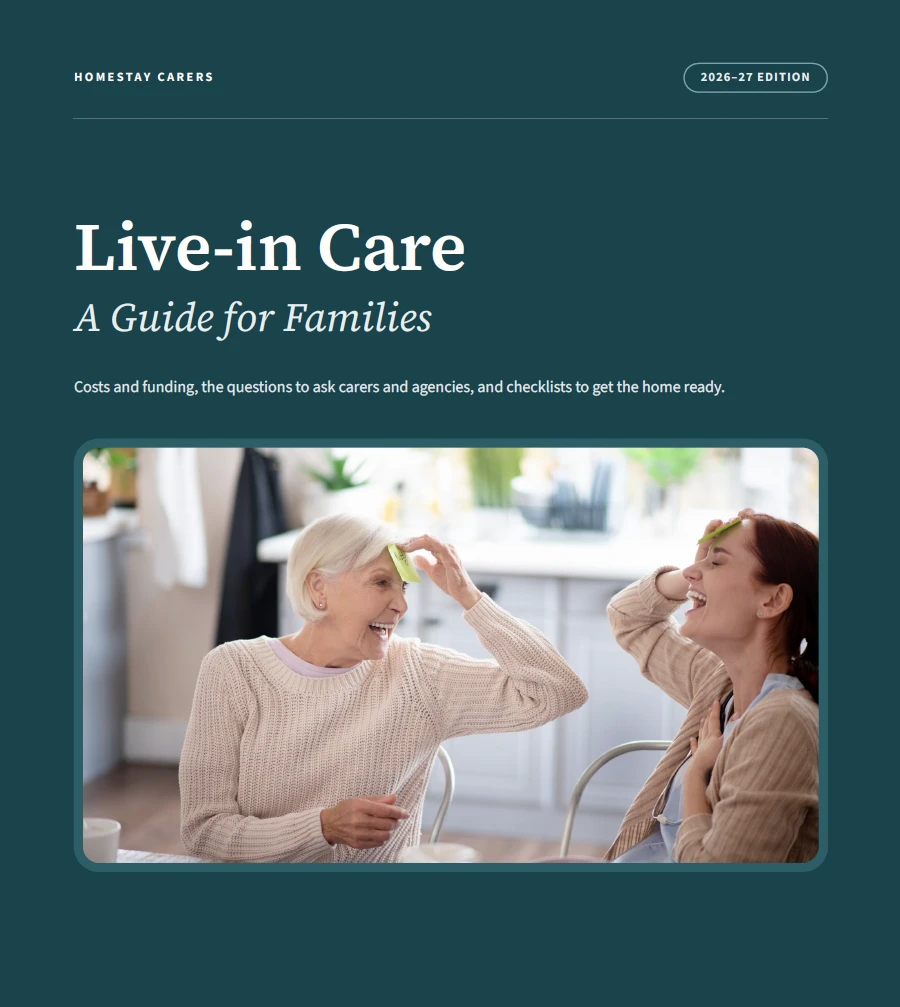
Live-in Care: A Guide for Families
Costs and funding, the questions to ask carers and agencies, and checklists to get the home ready.
Download the Planning Pack (PDF)Free, with no sign-up. Download the PDF to read or print it.
Browse our guides